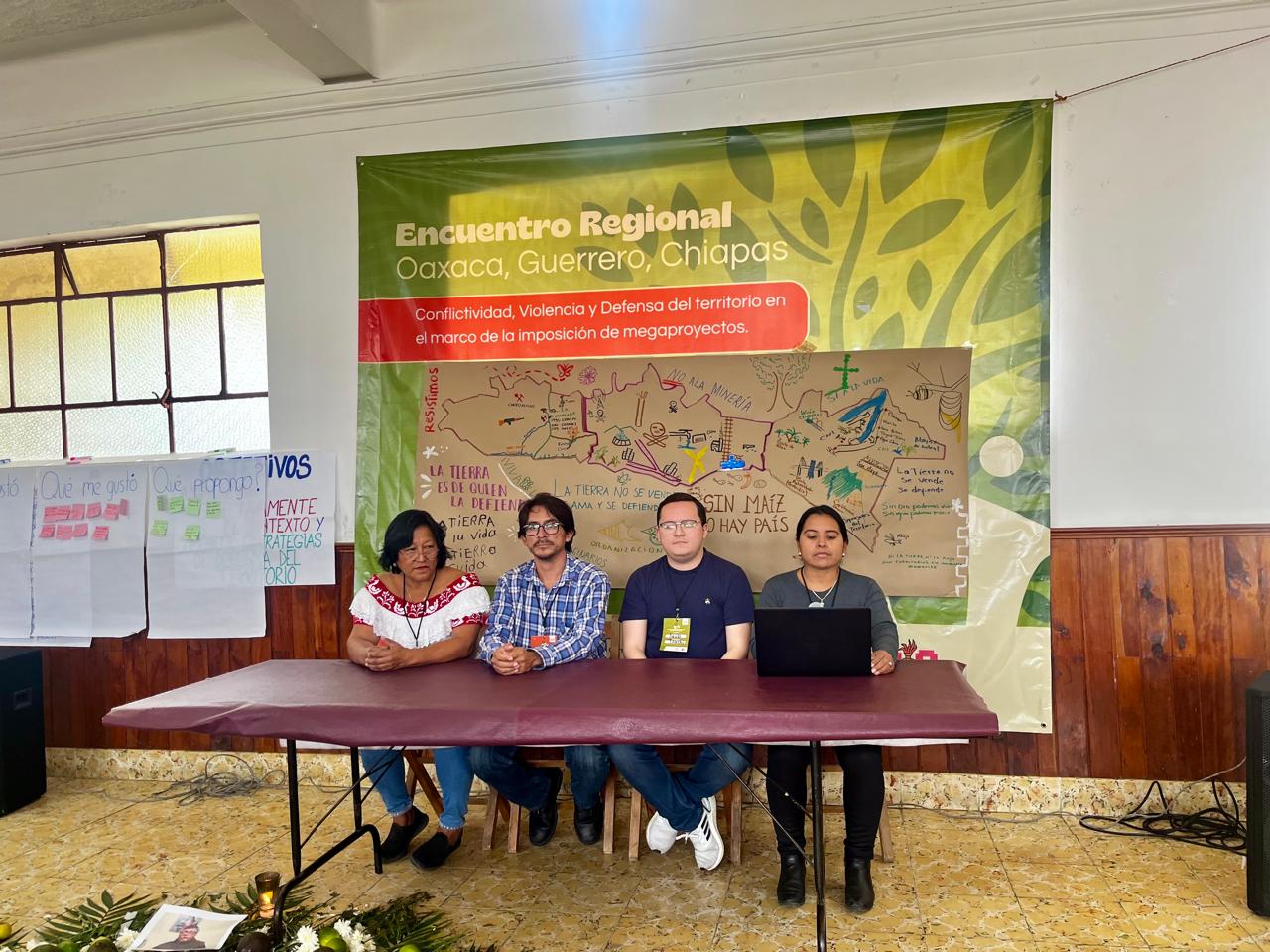
 Mexican communities and organizations from the states of Puebla, Oaxaca, Chiapas, and Guerrero met for a conference in San Cristóbal de Las Casas to strengthen their cooperation and network. Unified by oppression and sorrow through criminal aggressions, they tied their collaboration to further defend their territories in the south and southeast against expropriation, extractivism, and the planning of mega-projects.
Once again, the systematic threats, murders, and disappearances of activists were highlighted. Undeterred, the conference strengthened hope and served as a platform for a joint, determined demand for the right to sovereignty.
It provided a space for exchanging contacts, learning about forms of organization, and strategies for the use of social media and strengthening their political influence.
Quote from the declaration:
1. Indigenous peoples and peasants, who have historically protected and cared for the land, sustain ourselves through our own forms of political organization, an ancestral legacy from our grandmothers and grandfathers for the care of life and Mother Earth.
2. There is a historical continuity of dispossession of our peoples’ territories, from colonization to the current imposition of development hubs implemented by governments in collusion with corporations and organized crime.
3. Despite the aggression, violence, and dispossession we have suffered for decades, big capital, organized crime, and governments have not succeeded in subjugating our peoples. Thanks to community organization, we have stopped mega-projects, evictions, and acts of violence.
4. The defense of our territories has come at a very high cost: comrades committed to social justice have suffered murders, disappearances, threats, and attacks. The machinery of repression continues to operate in governments of all political stripes.
Furthermore, they illustrate how the government, companies, and organized crime have built a triangle of power to exploit, maximize profits, and grant immunity from prosecution. They can operate in the south as they want without including the actual landowner. For example:
In Chiapas, mining projects are expected to cover more than 85,000 hectares of the Zoque territory, which will have serious ecological and social impacts.
In Guerrero, the implementation of mining and tourism projects has destroyed the social fabric and increased violence against communities that organize to protect life.
In the Mixteca region of Puebla and Oaxaca, as well as in the central valleys of Oaxaca, there are attempts to establish mining projects in which the extraction of lithium, rare earths, silver, and gold is to be enforced for the sole benefit of the companies.
These are just some examples. There are a lot more projects on hold but not cancelled. As the plans of the mega-project of the Coyolopa-Atzalan hydroelectric power plant in Puebla or the “Margarita Maza de Juárez” dam in the Central Valleys of Oaxaca.
Furthermore, touristification, the construction of highways, and new infrastructure have only served to intensify raw material extraction and secure profits for companies, at the expense of dividing and displacing the communities in all the states. This is all covered by manipulated surveys, political jurisdiction, and under the pretext of development. But what is development if those directly affected do not benefit from it?
They experience these “developments” not as progress, but as the systematic plundering of their resources and destruction of their livelihoods for the benefit of corporations and state interests. Despite all this, they continue to engage in collective organization, resistance, and the defense of their land and lives.
They unanimously say no to gentrification, they say no to monocultures, and they say no to the mentioned mega-projects. They demand peace in their territories and want justice for those who had been killed while fighting for it. They say yes to their sovereignty, they say yes to their territories and they say yes to withstand against all repression together.
Read full declaratory: Nuestra fuerza es el territorio: pronunciamiento de pueblos y comunidades del sur-sureste
Video: link