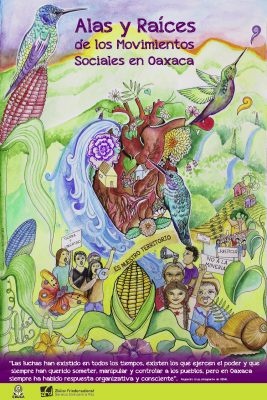
Monitoring: Alas y Raíces de los Movimientos Sociales en Oaxaca
(December 2022 – May 2025)
Servicios para una Educación Alternativa EDUCA A.C.
Introduction
This document presents an analysis of territorial conflicts, acts of resistance, and attacks against human rights defenders in Oaxaca, covering the period from the 1st of December 2022 to the 31st of May 2025. The timeframe corresponds to the first two and a half years of the current administration led by Salomón Jara and, therefore, of the Morena political party.
The research was conducted within a broader national context marked by increasing conflicts over land and territorial control, the expansion of national security measures and militarisation in the country, and the growing presence of criminal structures and illicit markets across Mexico. However, this analysis focuses primarily on the underlying causes of increased land dispossession and violence against indigenous peoples and social movements in southeastern Mexico, their criminalisation, and the resulting reduction of civic space.
Methodological Approach
To investigate the causes of the observed phenomena, EDUCA implemented three ongoing monitoring programs, each with their respective databases.
The first monitoring analyses aggressions against human rights defenders, documenting the circumstances of the attack, the form of attack and the possible attackers, among the most important factors. The second monitoring focuses on territorial conflicts in Oaxaca, their nature and justification, focusing on the actors involved in the conflicts, as well as institutional responses and the efforts of federal, state and local authorities to resolve the conflicts. The third monitoring documents acts of resistance and political organisation in Oaxaca and, thus, the population’s response to the conflicts.
The data this research is based on, is drawn primarily from cases reported in La Minuta by EDUCA, supplemented by information from other journalistic sources and human rights organizations. It should be noted that not all incidents of conflict have been recorded in our database, either because they were not publicly reported or due to a lack of corroborated information. We thus define a conflictive event as one that generates tension or confrontation between two or more parties and that was publicly reported through various media outlets. Accordingly, the information presented on these conflict-related events is both substantiated and backed by reliable sources. EDUCA believes that access to information is a fundamental citizen right and, for that matter, shares the systematization of its databases.
ONE. Criminalisation: The State’s Response to Community Defense.
In the first two and a half years of the current administration of Oaxaca, 44 individuals were attacked and 70 acts of aggression against groups, communities, collectives, organisations or social movements were documented.
Of all the attacks recorded, 27 were classified as attacks on life, covering three types of aggression: assasination, extrajudicial execution and enforced disappearance.
In these acts of aggression, a total of 32 human rights defenders were killed. These attacks on life constitute 20 individual homicides, 1 extrajudicial execution and 5 attacks against groups of people in which 11 human rights defenders were killed. It should be mentioned that during the covered period, 1 enforced disappearance was recorded; however, the disappeared person (Refugio Román Cortés Hernández) was found alive one month after his disappearance.
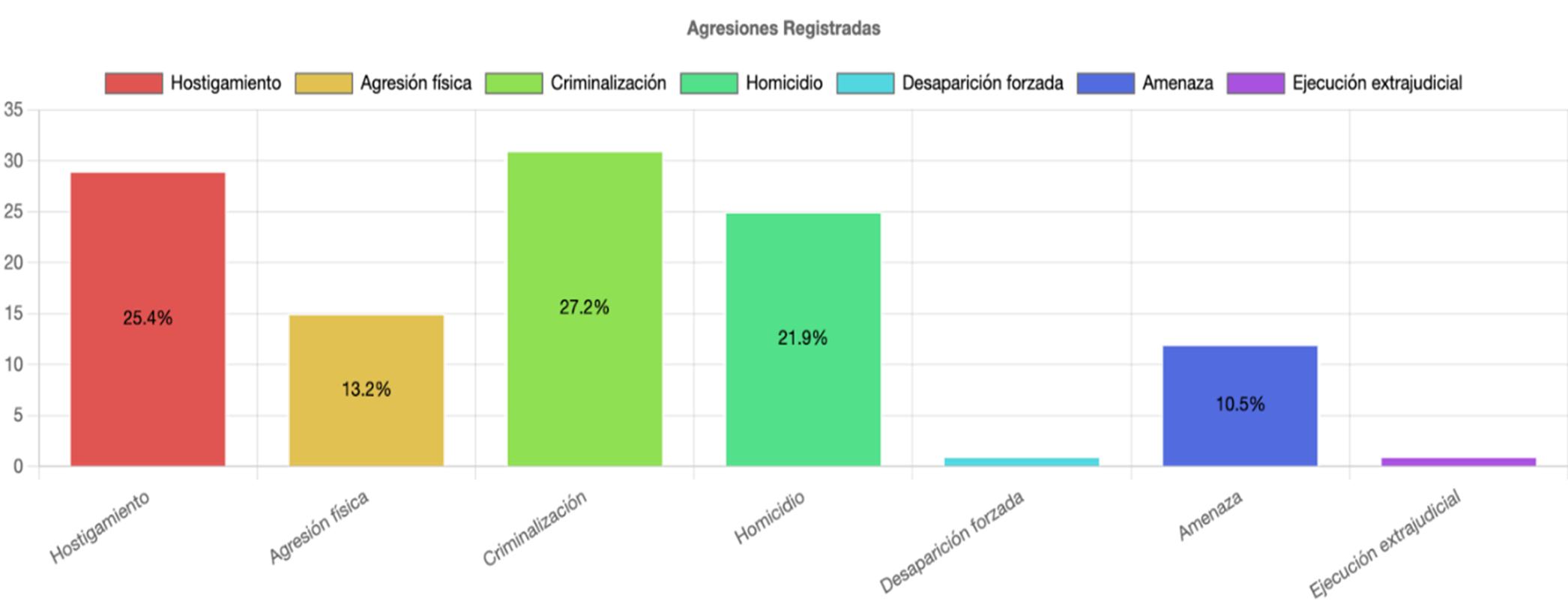
Registered aggressions by type
In the state of Oaxaca, the most frequent forms of aggression are criminalisation (31 cases), harassment (29 cases), and homicides (25 cases), which together account for 73.6% of all reported attacks.Of the total 114 recorded acts of aggression against human rights defenders in our database, we estimate that 355 individuals were attacked.
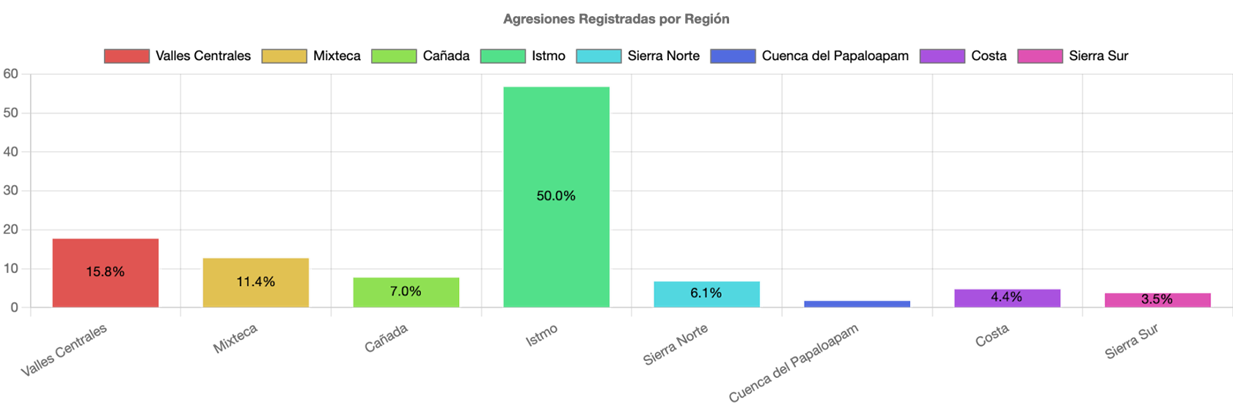
Registered aggressions by region
A worrying aspect that stands out in this monitoring is that the Istmo de Tehuantepec accounts for 50% of all recorded aggressions. These incidents are connected to the Interoceanic Corridor of the Istmo de Tehuantepec (CIIT), a project that has intensified attacks against human rights defenders in the region.
The predominant form of aggression documented in the context of its implementation is criminalisation. In the Istmo, 20 incidents of criminalisation were recorded, accounting for almost two-thirds of all attacks registered in the state. These 20 cases of criminalisation involve 136 human rights defenders.
A closer examination of the criminalisation of human rights defenders in Oaxaca reveals a pattern of excessive sentences. These ‘exemplary punishments’ for human rights defenders serve as a disproportionate response to their advocacy work, aimed at deterring and intimidating communities engaged in resistance. In relation to these excessive sentences, it is important to mention the cases of Miguel Peralta Betanzos, David Salazar Hernández and Pablo López Álavez, who received sentences of 50, 46 and 30 years, respectively.
It should be emphasized that the most frequently recorded aggressors are state authorities (24.6%), followed by powers that be (22.8%) and federal authorities (21.1%).
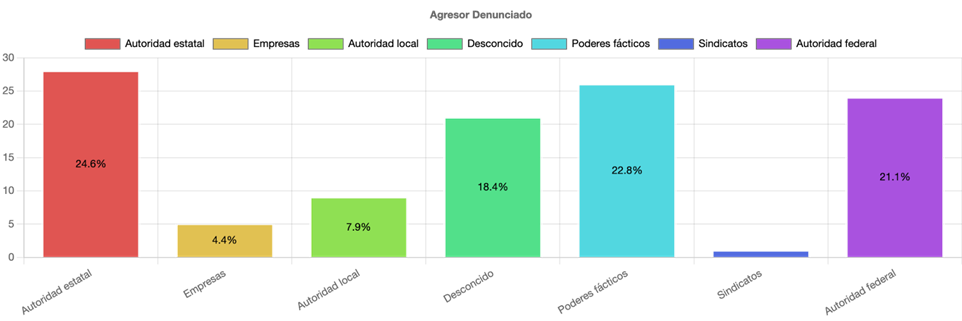
Reported aggressor, from left to right: State authorities, Companies, local authorities, unknown, non-democratically legitimized actors, syndicates, federal authorities
In this regard, one tactic used by the state to deter protest is the use of shock troops, a deployed strategy during adverse times and not applied anymore. Nonetheless, both in demonstrations against federal government megaprojects and in marches and blockades by indigenous communities, migrants and even women, violent civilian groups have reemerged, causing outbreaks of violence in public spaces. Furthermore, in territories occupied by organised crime groups, the boundaries between these powers that be, trade unions and the ruling party are beginning to blur. Examples include Agencia de Guadalupe Victoria in the municipality of San Juan Juquila Mixes, which suffered internal displacement of its community; Unión Hidalgo, in defence of its territory against the illegal extraction of its commons; San Antonio de la Cal, in opposition to the construction of a solid waste centre and Capulálpam de Méndez, in opposition to the illegal extraction of its minerals. In all these cases, we documented the presence of shock troops who attempted to violently repress their legitimate community defence. Concluding this section, is crucial to emphasize that 86% of human rights defenders who are victims of aggressive attacks belong to indigenous peoples, of whom 35.1% are Zapotec, 17.6% are Ayuuk-Mixe, 11.4% are Triqui, 7% are from the Mixtec people, 7% from the Mazatec people, and 8% belong to different peoples.
TWO. Omission and Provocation Aggravate Territorial Conflicts in Oaxaca
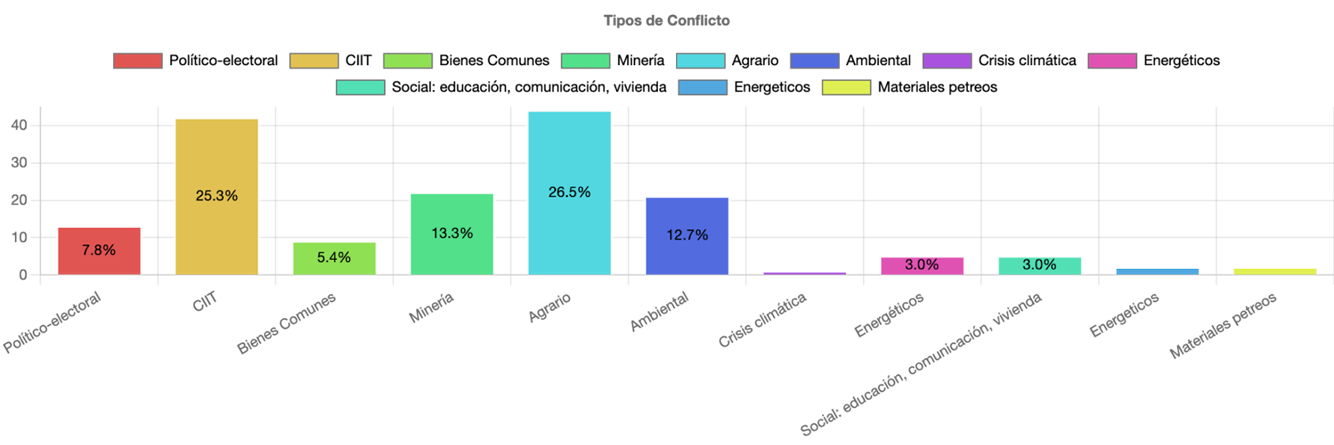
In our monitoring of territorial conflicts in Oaxaca, we have documented 166 incidents, averaging more than one conflict-related event per week. A more detailed analysis of the types of conflicts reveals that agrarian conflicts (44 incidents) and the imposition of the Interoceanic Corridor of the Istmo de Tehuantepec (CIIT) (42 incidents) as the most prominent sources of tension. These are followed by conflicts linked to the illegal operation of mining projects in the Valles Centrales and the Sierra Norte (22 incidents). Additionally, the dispossession of coastal lands for tourism development in the Costa region is emerging as a growing and increasingly concerning source of conflict.
 Taking a closer look at territorial conflicts across Oaxaca reveals the Istmo de Tehuantepec as the epicenter of unrest, accounting for almost half of all recorded incidents in the state (47.6%), followed by the Valles Centrales with 16.9%, the Mixteca with 11.4% and the Costa with 8.4%.
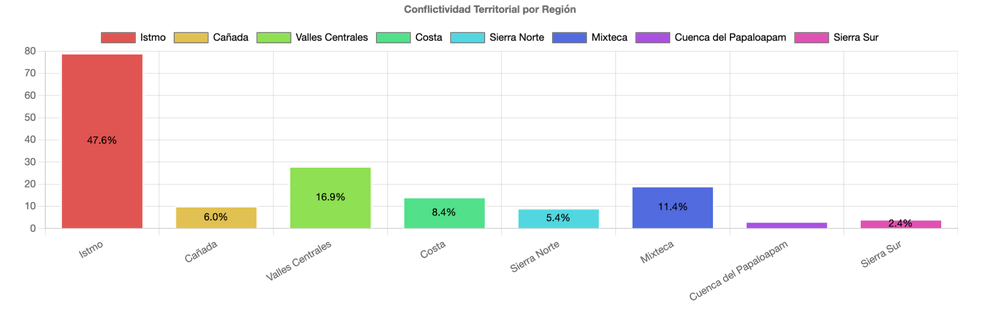
Territorial conflicts in Oaxaca by regions
Indigenous territories account for 96% of the total number of conflicts, representing a high level of vulnerability and lack of attention by state and federal authorities to address the conflicts.The principal drivers of conflict include the implementation of megaprojects, most notably the Interoceanic Corridor in the Istmo de Tehuantepec, mining operations in the Valles Centrales, and the ongoing touristification of the Costa region.
It is worth mentioning that the percentage increase of unrest in the Mixteca region is mainly due to an agrarian conflict, which received a great deal of political and social attention due to public pressure (we are referring to the Villa de Guadalupe Victoria – Llano de Guadalupe conflict). Supplementing this scenario is the Triqui conflict, a violent dispute between powerful groups and communities over political and territorial control, a conflict that has led to forced displacement, assassinations and a humanitarian crisis that has lasted for decades.
Among the 166 recorded conflicts, the primary responses from state authorities (manifested through their approaches to conflict resolution) were: omission (38%), provocation (28.3%), and conflict management (15.1%). These numbers are concerning. The way state and federal authorities have addressed the situation has contributed to an increase in social and political conflicts and unrest, including incidents of assassination.
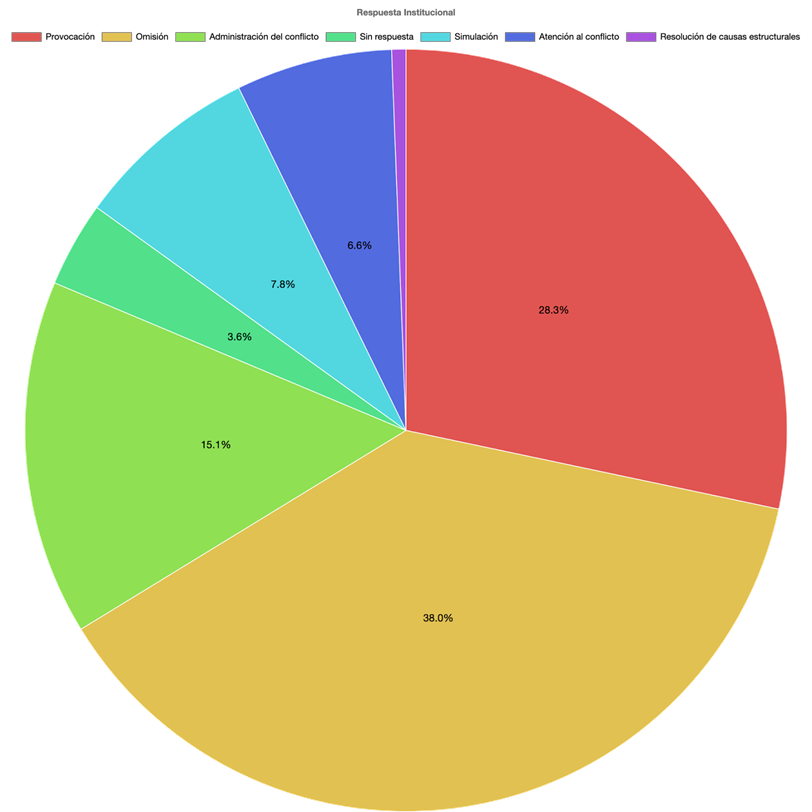
It is important to emphasize the role of local authorities – both municipal and agrarian – as well as the judiciary, whose interventions in resolving territorial disputes have contributed to a reduction of conflicts in different regions, particularly those related to political-electoral tensions, agrarian disputes, and the dispossession of commons (6.6% of conflicts). Nevertheless, despite court rulings and internal agreements between municipal and agrarian authorities, the actions of state and federal authorities have reignited or intensified conflicts.
Concerning the autonomy and territory of communities affected by mega-investment projects, we have recorded that in several conflicts, state and federal authorities violate community agreements. Just to state some examples, as is the case of Puente Madera, Unión Hidalgo and Santa Cruz Tagolaba in the Istmo of Tehuantepec and San Pedro Quiatoni and other communities in the Valles Centrales opposed to mining. Even when there are court rulings in favour of the communities, they are often disregarded and illicit economic interests and powers that be prevail. Besides, the lack of access to public information and the lack of access to justice are a constant feature of these projects.
THREE. Strategies of Resistance and Community-Based Peace.
In response to the challenges outlined above, Indigenous peoples, communities, and social movements in Oaxaca there is a lot of widespread, popular, grassroots action. These actors have pursued autonomous strategies to address and resolve conflicts, thereby playing a crucial role in preserving the social fabric in the state.
The reactions of communities in the Istmo, Valles Centrales, and the Costa are characterised by a diversity of defence tactics and strategies varying from legal action to direct action. This indicates that social movements and communities still have faith in state institutions. At the same time, they exercise their right to free demonstration and mobilisation. In the conflict scenario described above, we documented 149 acts of resistance, equivalent to at least one act of resistance per week.
It should be noted that half of the registered acts of resistance correspond to demonstrations, blockades, and celebrations, which are the most commonly used forms of action.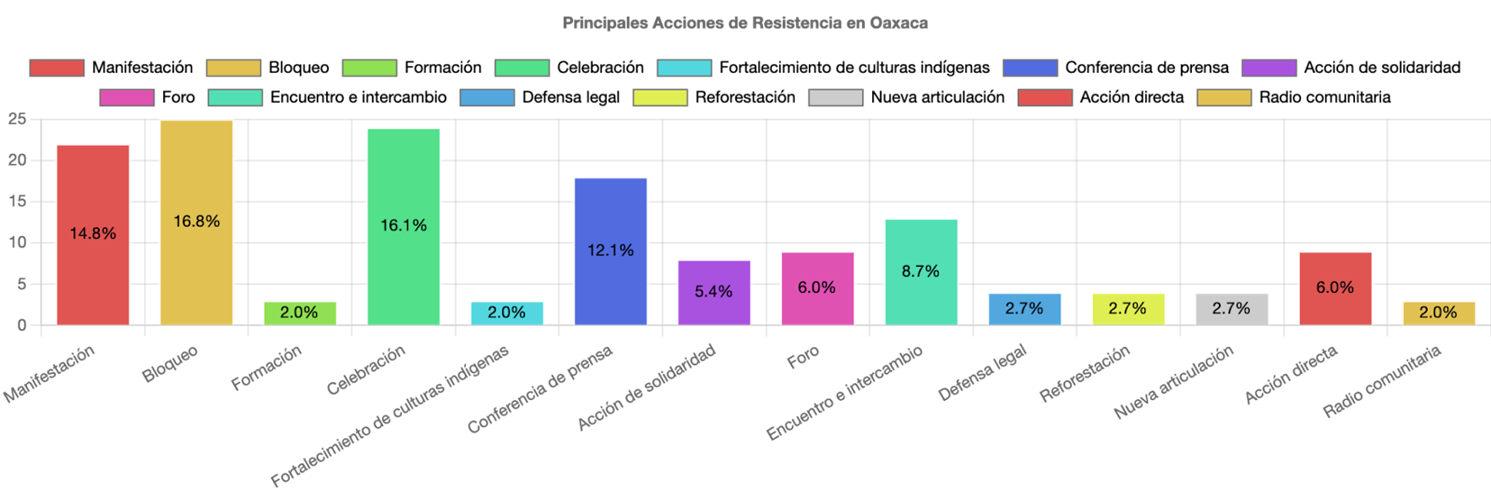
A range of strategies and alternative responses to conflict and violence have also been emerging, centered largely on acts of solidarity among communities, peoples, and movements. These include the organization of public forums and press conferences to promote awareness, strengthen cultural identity, and support the restoration of sacred and spiritual sites. If Oaxaca is characterised by anything, it is by its organisational strength and creativity in its forms of resistance.
The acts of resistance recorded show a clear consensus of political organisation in two regions, the Valles Centrales and the Istmo, which stand out from the other five regions with 50 and 55 acts of resistance respectively. These two regions are followed by the Costa with 17 acts of resistance.
This data supports the hypothesis that both the megaproject Interoceanic Corridor in the Istmo and the mining projects in the Valles Centrales are the main causes of political resistance, territorial conflict and unrest. Likewise, the high number of acts of resistance recorded in the Costa region points to the recent phenomenon of touristification as a significant source of emerging conflict and opposition.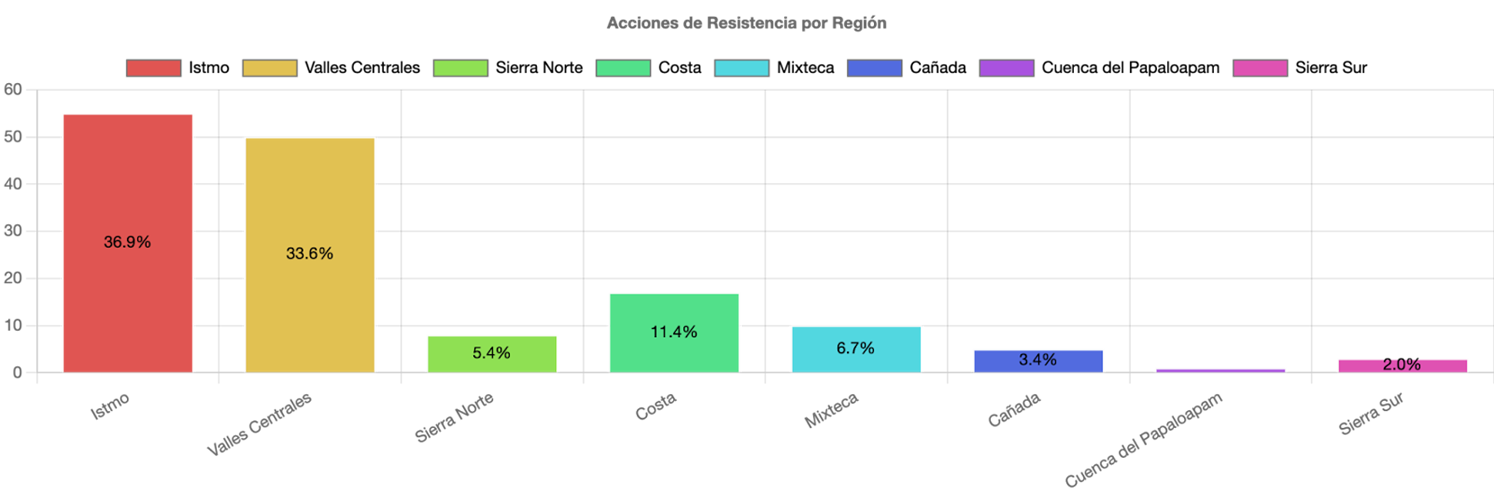
Conclusion
Over the past two and a half years, southeastern Mexico has witnessed a steady intensification of illegal land and territorial appropriation, accompanied by rising levels of violence and criminality. This is closely tied to the imposition of megaprojects associated with the Fourth Transformation’s economic agenda and projects, initiatives that are being primarily imposed in indigenous territories (90% of the communities and movements in resistance belong to an indigenous people).
Measures promoting extractive megaprojects and the ongoing integration of the Istmo region into the international capitalist market reveal clear violations of human rights. Under duress of the increasing militarisation of the region and transnational corporations and criminal structures gaining more and more ground, it is becoming increasingly difficult for communities to defend themselves against land dispossession, environmental destruction and cultural exclusion. Even more so, they are paying with their lives defending their basic human rights.
The closer analysis and systematisation of the recorded data as part of this monitoring on attacks on human rights defenders, territorial conflicts and acts of resistance, focusing on the first two and a half years of Salomón Jara’s government, clearly indicate that indigenous peoples are increasingly being criminalised. In addition to revealing obvious threats to human rights, the figures presented illustrate the growing repression of social movements and freedom of organisation, which represent a threat to democracy in Oaxaca and explicitly show that the scope of action of civil society is increasingly being restricted (shrinking civic spaces).
As explained, territorial conflicts, acts of resistance, attacks on human rights defenders, and the resulting repression of social movements are concentrated in the regions of the Istmo de Tehuantepec, the Valles Centrales, and the Costa. The data reinforces the thesis that the implementation of megaprojects, particularly the Interoceanic Corridor, mining operations, and tourism, have been a central factor of increasing conflict and violence in Oaxaca. A closer examination reveals that 54.4% of the documented aggressions were directed at individuals defending their rights to land and territory, highlighting the disproportionate impact of these projects on communities engaged in territorial defense.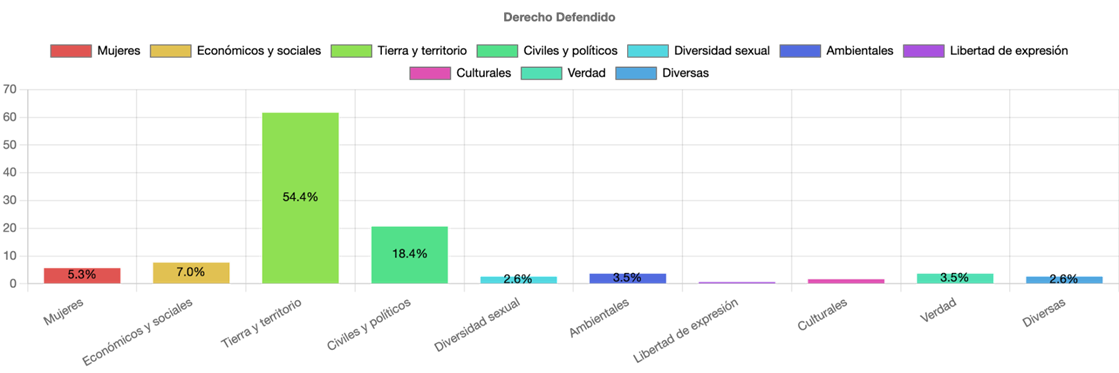
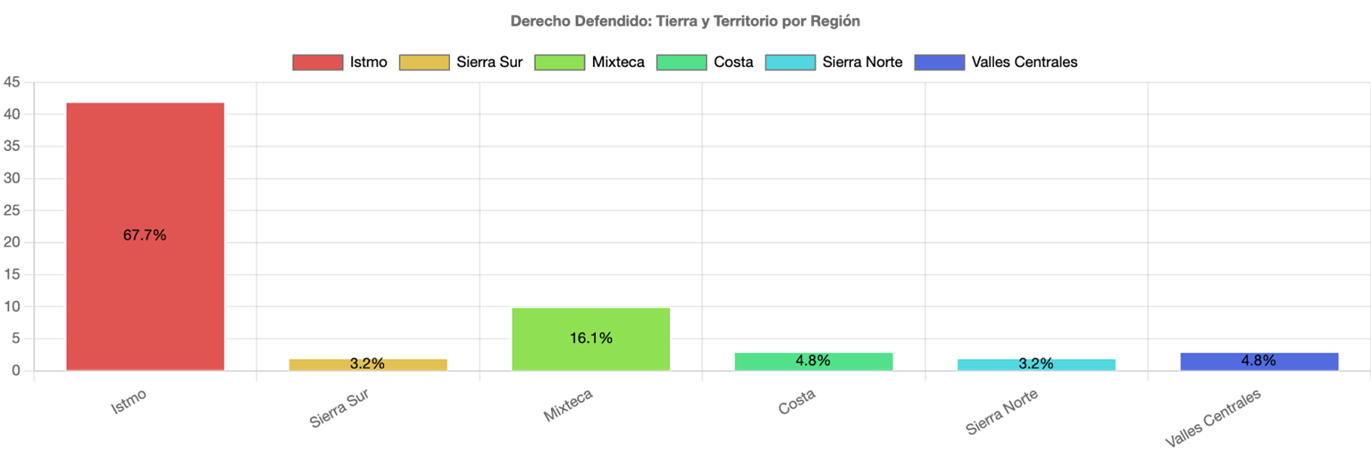 67.7% of these aggressions occurred in the Istmo de Tehuantepec, followed by the agrarian conflict in the Mixteca, with 16.1%, and again the Valles Centrales and the Costa with 4.8% each. These numbers not only support the aforementioned thesis, but also show that the implementation of the Interoceanic Corridor in the Istmo de Tehuantepec has massively promoted conflicts over control of land and territory and, with it, the dispossession and displacement of communities and thus, the associated spiral of violence, which is now reaching its peak between 2022 and 2025.
The institutional response of the State to the circumstances described in the second part, with 38% omission and 28.3% provocation, shows a lack of political interest on the part of the current government in resolving conflicts and responding to the demands of the population. On the contrary, it could be interpreted that repression for economic interests is a strategy of the State and national and transnational companies to promote their projects, while the affected communities aren’t being taken into account; Rather, their defence is criminalised with the fabrication of criminal offences.
Amid the critical context outlined above, the analysis of acts of resistance offers a vital glimmer of hope. The frequency and regional concentration of these actions, particularly in the Istmo de Tehuantepec, the Valles Centrales, and the Costa, demonstrate that, despite all the threats, including assasination, communities continue to stand firm in defense of their territories, communal life, and autonomous ways of living and organizing.
Campaign: Alas y Raíces de los Movimientos Sociales en Oaxaca, 09.08.2025
_________________________________________________________________________________________________
1. It is noteworthy that, in the cases mentioned here, the main aggression committed is recorded. Therefore, a case such as that of human rights defender Sandra Estéfana Domínguez Martínez (who disappeared for seven months – 206 days – and then was found dead) is represented in the graph as a homicide, and not as enforced disappearance.
2. It must be emphasized that, in the cases of aggressions aimed against collectives or groups, it is not always possible to clearly determine the number of people who were attacked. Thus, aggressions against demonstrations or collectives, to cite a few examples, were recorded with a number of 0 individuals attacked. Similarly, there are aggressions against collectives in which the number of people attacked is specified.