
Categoria

English

Since 1994, Educa A.C., as a civil organization, accompanies social movements, advises social organizations and indigenous communities in the defense of their social and civil rights, promotes civil and political education, advocates for the integral protection of human rights, and initiates projects of sustainable, rural development in the state of Oaxaca. As part of our strategy to promote civil and political education, we translate some of our publications into English and founded the Twitter account “Human Rights Oaxaca Mexico” to address an international audience. In the globalized world, we live in, today’s problems need to be viewed from different perspectives in order, to be solved. Therefore our work in English intends to give Oaxaca’s civil society a voice, create awareness and promote public dialogue. We cover topics such as social movements, gender and migration violence, territorial and environmental conflicts, indigenous resistance against transnational megaprojects, as well as other current issues Oaxaca’s civil society finds itself confronted with.

Visit our Twitter account

On Mexican Isthmus, Indigenous Communities Oppose Massive Energy Projects English

On Mexican Isthmus, Indigenous Communities Oppose Massive Energy Projects

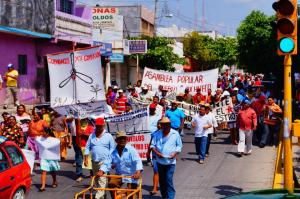
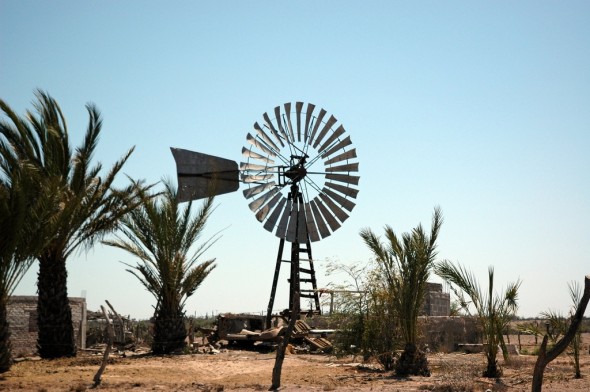
The wind corridor of the Isthmus of Tehuantepec, stretching across the southern Mexican states of Oaxaca, Chiapas, Tabasco and Veracruz, is one of the most important in Latin America in terms of corporate investment and profits. Of the 28 farms in the region, all of which are located principally on indigenous communal lands, construction is halfway complete. This has led…
HagamosWeb
10 abril, 2014
wind farm jen
Cancellation of Mexican wind farm highlights flaw in green transition English

Cancellation of Mexican wind farm highlights flaw in green transition

Mexico has the fastest-growing wind power industry in the world, making it an important case study in the first steps of a global transition towards renewable energy. However, in the windy Isthmus region of Oaxaca, this rapid growth has been accompanied by ongoing conflict and social unrest that puts the future of these projects in jeopardy. For the past two…
HagamosWeb
7 abril, 2014
ttp cip
NAFTA linked to Massive Human Rights Violations in Mexico English

NAFTA linked to Massive Human Rights Violations in Mexico

In a series of preliminary opinions, an international tribunal of conscience has condemned massive violations of human rights in Mexico. Now wrapping up a four-year process of evidence gathering,  members of  the Mexican chapter of the Permanent Peoples Tribunal (PPT) have found grave threats to  the environment, food sovereignty, indigenous autonomy, and  democratic rights of self-expression and organization of the…
HagamosWeb
7 abril, 2014
“It was a massacre” English

“It was a massacre”

This article was first published on Noticias, Voz y Imagen de Oaxaca on 18 May 2013, and was republished via that newspaper’s portal NoticiasNet.Mx on 21 March 2014 in recognition of its author winning the 2013 Premio Nacional de Periodismo (National Journalism Award). Vélez Ascencio has worked as a reporter for 30 years, with the last two decades at the…
HagamosWeb
25 marzo, 2014
Joint-Statement-Mexico
Briefing on EU-Mexico Human Rights Dialogue English

Briefing on EU-Mexico Human Rights Dialogue

Ahead of the EU-Mexico Human Rights Dialogue, which took place in Brussels on the 18th of March, Protection International together with PBI (Peace Brigades International), CIFCA (Iniciativa de Copenhague para Centroamérica y México) and Front Line Defenders submitted a joint briefing, reporting that HRDs in Mexico continue to suffer attacks, threats, harassment and murders. The four signatory organizations have identified…
HagamosWeb
21 marzo, 2014
oaxaca clinic
No reproductive justice for pregnant indigenous women in Mexico English

No reproductive justice for pregnant indigenous women in Mexico

In October of last year, Irma Lopez Aurelio arrived at a state health clinic in Oaxaca, Mexico, in labor with her third child. The doctors at the clinic told her to come back, that her labor was not advanced enough and no doctor was available to help her. Irma, who is Indigenous, spoke little Spanish and was unable to communicate how advanced her labor…
HagamosWeb
18 marzo, 2014